


Profile
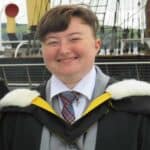
Aurelia Zuchanke
-
About Me:
I’m a theoretical physics PhD living in Liverpool. In my spare time I like baking, playing video games, and going to the gym. I also play an excessive amount of D&D.
-
Read more
I’ve loved maths and physics since I was young. I wanted to know why everything was the way it was. The final answer was always “we don’t know”, but it almost always got there through physics. Wanting to learn more is why I studied physics at Bristol. Since I ran out of fundamental physics I could learn from a course, I decided to give research a try, and ended up in a PhD at Liverpool.
My interest in computers started quite young, and mostly came from playing games on a PC. I can draw a line directly from my current computationally focused research back to figuring out how to mod Minecraft on my mum’s computer.
Growing up, I played a lot of Roll-playing games with my friends. Naturally, I joined a D&D campaign at university, and have been in various groups since, currently playing in two groups once a week each.
-
My pronouns are:
She/Her
-
How I use Maths in my work:
The physics I simulate on a computer is all described by a mathematical model. The hardest bit is taking a big complicated function, and finding out how to reverse it. This involves lots of repeated steps involving matrices, which are are really a special way to write a collection of numbers.
-
My Work:
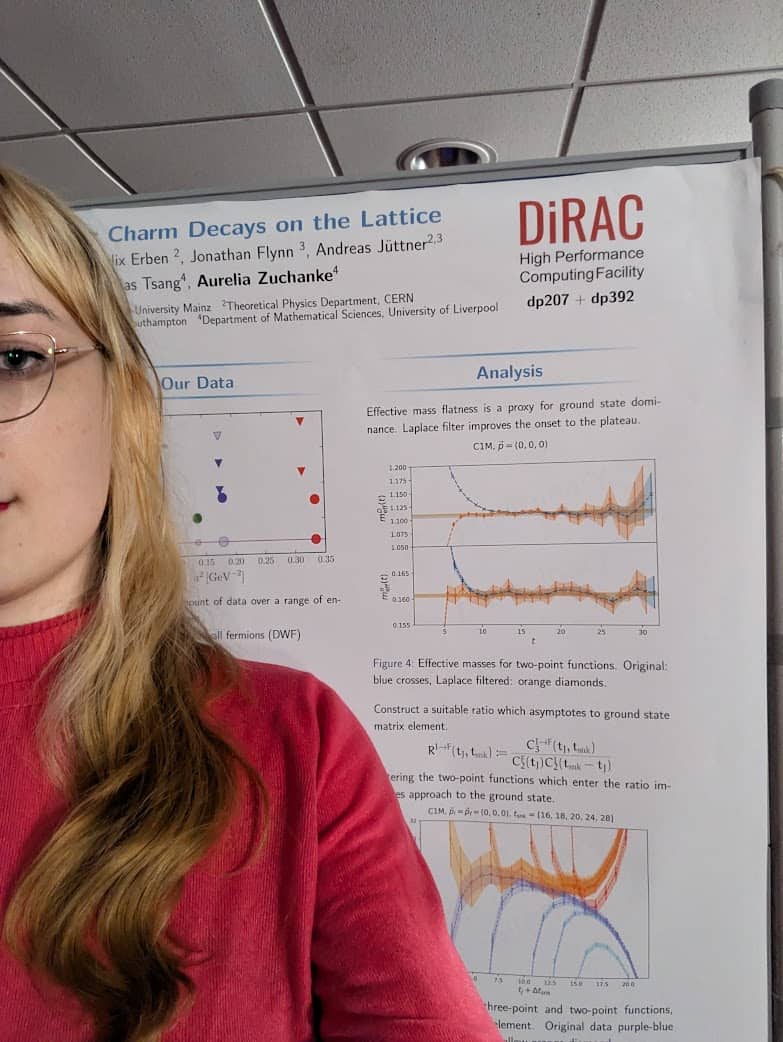
I try to figure out how the force that holds atoms together works, and if there’s some new physics we don’t understand involved. Because these calculations are really hard, I have to do them on super computers.
-
Read more
My work is all about the strong force, which holds atoms together. Atoms are made of protons and Neutrons, which are made up of quarks. Quarks are just particles, like electrons, but we only find them together in groups, usually two or three. We have a really good model for how they work, but the calculations for actual predictions are really hard, and we can’t do them in the normal way we do for other particles. Instead, we use a type of method called Lattice QCD, which is just a name.
The calculations are still hard, but we can do them. Because they involve so many steps, we get a computer to do them, and not just a normal computer, but really big computers. We can compare the results we get to particle experiments, like the LHC at CERN. By doing this carefully we can try and find new things we didn’t know about before.
-
My Typical Day:
I, reluctantly, wake up around 8 and get ready for the day. I’m in my office by around 10. Most of my day is usually spent writing computer code, checking results, and reading/meeting to talk about what interesting things other people have done. I try to go home around 6.
-
Read more
Being a theoretical physicist, I don’t work in a lab. Instead, but with computers and whiteboards. Because of that, I can mostly choose the hours I work. I’ve always been a night owl so I usually come and go a bit later in the day, at least when I don’t have a 9AM meeting!
Most of my day is spent working on a computer. Mainly generating and analysing data. I do this by writing and running code. My work is very collaborative, so I have a few weekly meetings with my various collaborators, and my supervisor.
I usually go home around 6. The flexibility of my work can make me make it tempting to work long, but I try and keep a good work life balance, so I leave my work at the office, and almost never work on weekends.
-
Education:
I went to a very small school in Devon. For my A-levels, I went to Exeter Mathematics School. I did my bachelors degree at Bristol University, and moved to Imperial for my masters.
-
Qualifications:
9 GCSEs, including triple science and computer science.
My A-levels were Maths, Further Maths, Physics, and Computer Science.
Bachelors degree in physics, which is a typical university degree.
A masters degree in theoretical physics (Quantum Fields and Fundamental Forces), which is a sort of special more advanced qualification you can do after you’ve finished your normal degree.
-
Work History:
When I was teenager, I ran and baked for a cake stall.
I had a summer research position in the experimental particle physics group at Bristol. It helped me decide I wanted to do research
-
Current Job:
PhD student, which is a sort of trainee researcher. I’m half a student, half an academic. If I finish it, I get to be called Doctor! (The medicine people stole the name from us. We had it first!)
-
Employer:
The University of Liverpool, Mathematics Department, Theoretical Physics Group.
-
My Interview
-
How would you describe yourself in 3 words?
computational physics nerd
What did you want to be after you left school?
A scientist, but I also briefly wanted to be a farmer and then a chef.
Were you ever in trouble at school?
Not really. I was too quiet/shy.
If you weren't doing this job, what would you choose instead?
Probably work in IT/tech, or maybe a baker.
Who is your favourite singer or band?
Charlie XCX
What's your favourite food?
Homemade vegi pesto pasta
If you had 3 wishes for yourself what would they be? - be honest!
Infinite wishes
Tell us a joke.
A mathematician wakes up in a burning building. Frantically looking around for an escape, they spot a fire extinguisher. "Ah, so there is a solution." They then promptly go back to bed.
-